
Dearing Court Docket Searches
Dearing posts no municipal docket interface. Start with the paper in hand. The court, agency, citation or case number, party name, and date tell you who holds the file. The official Dearing public-servants page names town officials and their contacts. But no municipal judge or court clerk appears there. That is a routing fact, not proof your case vanished.
If the notice names McDuffie Superior Court, Georgia's E-Access directory points to PeachCourt. Magistrate, Probate, and Juvenile matters run through their own offices. A citation may name a court tied to the issuing agency. Never assume nearby Thomson Municipal Court received it.
- Copy the issuing agency and court name exactly.
- Identify the citation or case number and party spelling.
- Use the named court's official clerk or portal.
- Read the charge, status, and setting as separate fields.
- Confirm the date and location with that clerk.
No Listed Dearing Municipal Court
Dearing's official town pages name the mayor, council, address, phone, and public hours. No municipal court, court clerk, docket calendar, or ticket-payment service appears anywhere on them. County planning material lists only two incorporated places, though incorporation by itself never creates a public docket portal.
Myth: every incorporated town runs an online municipal docket. Fact: the official sources name no Dearing municipal court channel. Use the court printed on the case paper.
Knowing this saves real trouble. It keeps sensitive case details away from an administrative office that does not hold the file. It also stops a Dearing citation from being paid in Thomson just because Thomson has the nearest visible payment site.
Inside Dearing Court Routing
The official public-servants source shows Dearing's town administration.
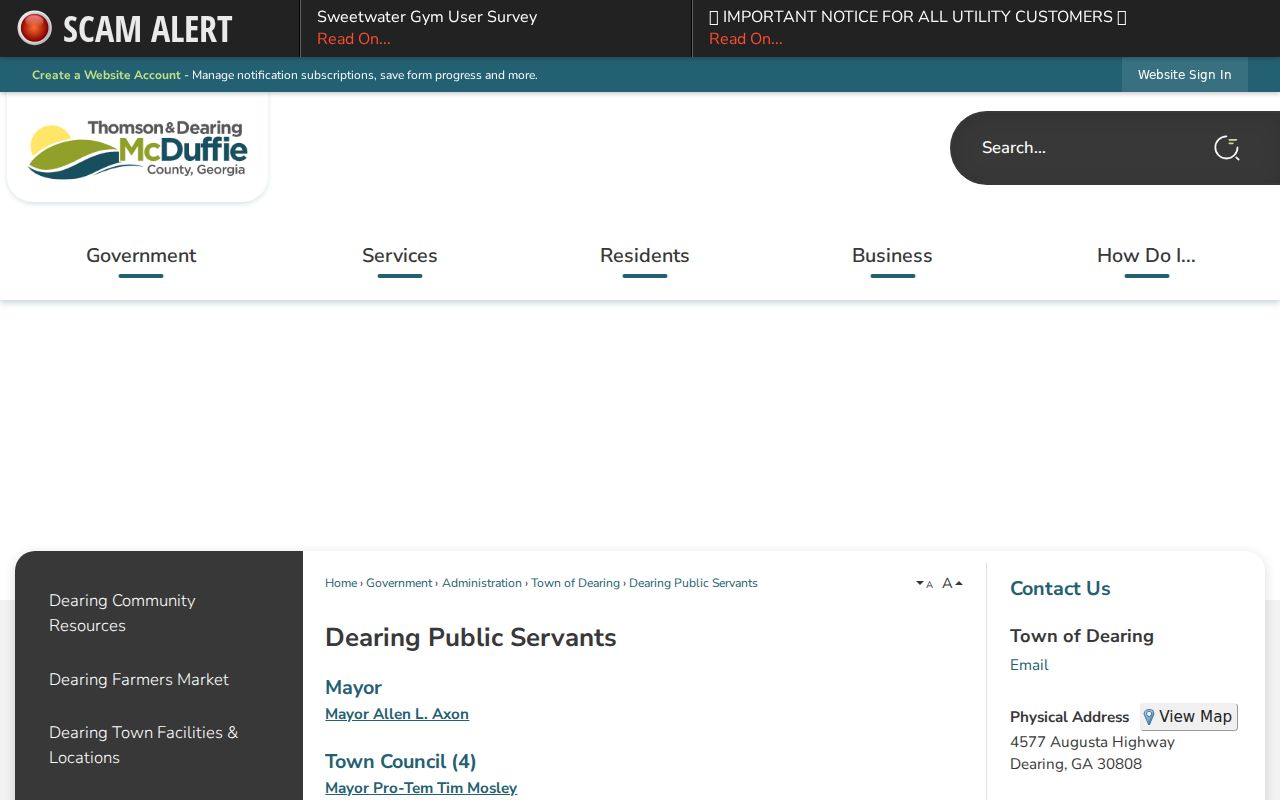
No municipal court or docket clerk appears in Dearing's listings, though the official facility page shows Dearing Town Hall as the town's building.
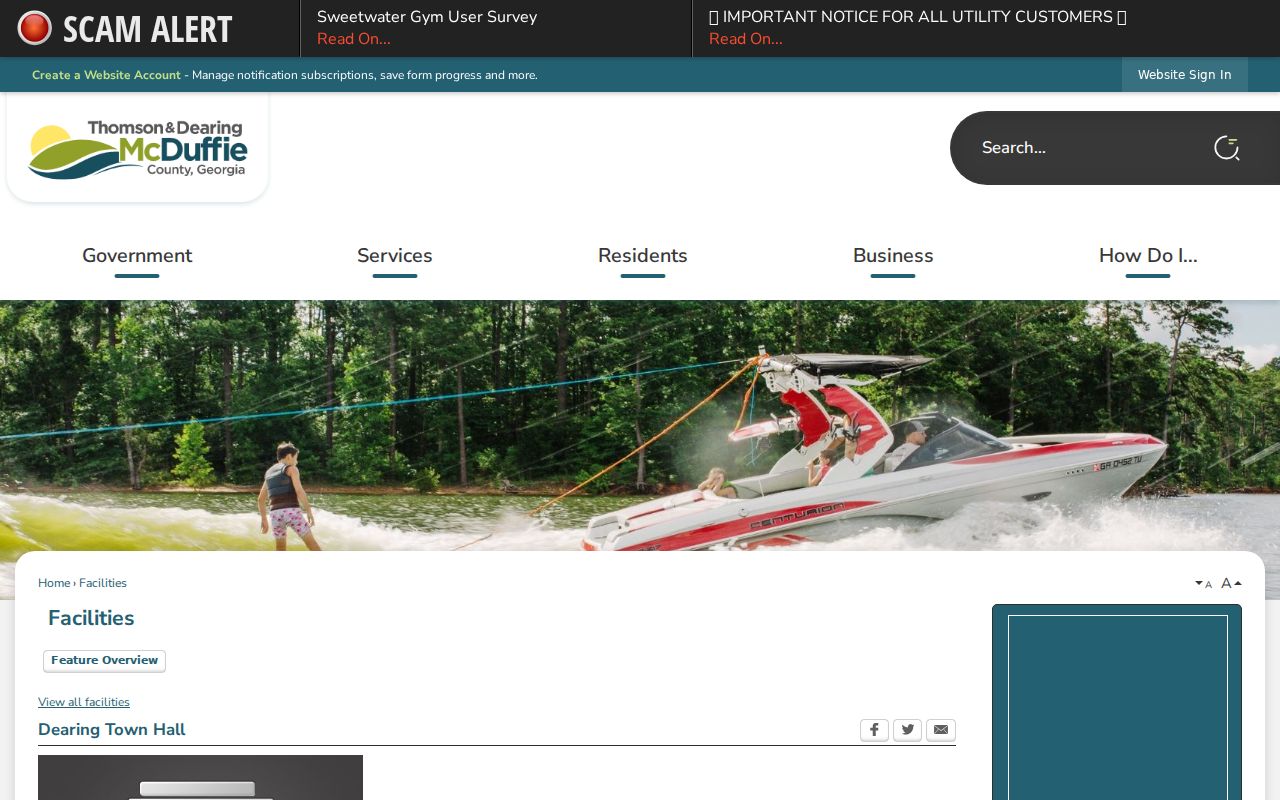
The town facility is not identified as a court-record counter.
Nothing supports describing a Dearing Municipal Court docket. Jurisdiction always comes from the receiving court instead. McDuffie Superior Court handles felonies and broad civil matters. Magistrate Court covers claims up to $15,000, dispossessories, garnishments, warrants, and first appearances. Probate and Juvenile matters stay in their specialized offices.
A traffic citation gets routed by its named court and issuing agency. If the designation is unclear, call the agency that issued it, then confirm with the court before paying. Town Hall can share town administrative contacts. Its official page, though, never says staff store dockets, accept court payments, or set hearings.
Dearing Town Hall Is Not Court
Dearing Town Hall sits at 4577 Augusta Highway, Dearing, Georgia 30808-4067. The facility number is 706-556-0384, and the public-servants page gives 706-986-5910. Both are town contacts. Neither source presents the building as a court-record counter.
Office hours run limited, including Thursday from 10:30 a.m. to 2:00 p.m. Phone or appointment details are also shown. Call before visiting for town business. For a court record, call the office named on the legal paper. That distinction can spare you a trip to a building with no authority over the case.
Finding Dearing Court Dates
A Dearing address does not fix the hearing court. Read the citation or notice. It lists the court, date, time, case number, and address. Calendar entries can change later through an order or continuance. The officer's paper is the starting clue, while the receiving clerk holds the current setting.
Published McDuffie Superior calendars may show a case number, caption, status code, cause, filed date, and attorney information. The codes CL, OP, and JR appear with no local public legend. Do not guess at meanings. Ask the clerk what a code means in that calendar.
| Date | Use the current court notice or clerk confirmation |
|---|---|
| Time | Distinguish calendar call from a case setting |
| Location | Use the court address, not Dearing Town Hall by default |
| Court | Read the full named jurisdiction |
| Setting type | Ask the clerk if a code is unclear |
Call the Named Clerk First
Before driving from Dearing, ask three things. Does the office have the case, and is the setting still active? Can a copy come by mail or another method? McDuffie Superior and Magistrate access sits at 210 Railroad Street, Room 1401, Thomson. The Superior Clerk's main line is 706-595-2134.
The clerk pages publish no appointment rule, terminal schedule, copy-order cutoff, or certified-copy turnaround. A call matters most for older paper files and authenticated documents. Keep the full case number handy. The office routes civil, criminal, juvenile, and real-estate work on separate lines.
Quick answer: Dearing Town Hall is not the court counter. Confirm the actual holder of the file before leaving town.
Dearing Traffic Ticket Lookups
Georgia keeps no centralized traffic-citation database. The Georgia Courts ticket page explains the search fields. Participating services may search by name, birth date, citation number, case number, or issuing city and county. Those fields still do not tell you which service Dearing uses. The official town sources expose no Dearing portal fields.
Give the receiving court time to process a new ticket. State guidance says seven to twenty-one business days can pass before a participating service shows it. A missing result does not erase the date. Contact the issuing agency or named court. See McDuffie County Traffic Court for payment, appearance, missed-date, and driver-record distinctions.
Do Not Assume ThomsonPay
Thomson Municipal Court offers ThomsonPay for eligible Thomson citations, and that is where its usefulness ends. The portal is not a countywide docket. Dearing sits next door and shares McDuffie County, but proximity never moves jurisdiction, so a payment sent to the wrong portal can stall a case rather than resolve it.
| Clue | What it tells you | Next step |
|---|---|---|
| Issuing agency | Who initiated the citation | Ask where it was filed |
| Court name | Likely record custodian | Use its official contact |
| Citation number | Search and payment identifier | Preserve every digit |
| Setting address | Where appearance is directed | Confirm before travel |
Never treat a vendor dropdown as stronger evidence than the citation and clerk confirmation.
How Dearing Cases Reach the County
One incident in Dearing can scatter its records across several courts. A felony charge lands in Superior Court, while a small civil claim, dispossessory, warrant application, or first appearance typically belongs to Magistrate. Probate and Juvenile keep their own tracks, so read the source paper and the subject matter to learn where a McDuffie County case actually went.
Docket flow: Dearing event or citation › court named by the issuing agency › McDuffie court with jurisdiction when applicable › Georgia appellate court when review is authorized.
Superior Court cases route through the Georgia E-Access directory, which sends McDuffie County to PeachCourt after you create a free account. Lower courts stay outside that search. To weigh every county route side by side, use the McDuffie County court docket.
Dearing's Small Civic Footprint
Dearing counted 529 residents in the 2020 Census across roughly 0.8 square miles. Incorporation came in 1910. Planning documents from the county name Dearing and Thomson. They are McDuffie County's only two incorporated places. Those numbers explain the town's small administrative scale. They say nothing about case volume in its courts.
The town's web presence centers on administration, while county court access runs through Thomson. That split makes careful routing far more useful than hunting for a Dearing docket screen that does not exist.
Who Can See Dearing Court Records
Access always follows the court holding the record. The McDuffie Superior Clerk treats civil and criminal files as open to inspection and copying. Juvenile, adoption, and sealed records are excepted. A docket line can be public even when a protected attachment stays withheld or redacted.
The Georgia Attorney General's court-record guidance shows why the general agency form will not work for court files. It explains the split plainly. Send any judicial-record request straight to the responsible clerk. Reserve the county or town open-records process for administrative material that entity actually holds.
Key rules:
Uniform Superior Court Rule 21 begins with public access while permitting lawful restriction, sealing, and redaction.
Georgia Open Records Act, O.C.G.A. §§ 50-18-70 through 50-18-79, governs covered agency records but does not replace a court clerk's procedure.
Verify Dearing Court Records
An online docket entry is a locator. It is not an authenticated record. For a certified McDuffie Superior or Magistrate document, the eCertification workflow produces a secured PDF once the clerk processes it and payment is authorized, and the request itself names McDuffie County, the court, and the document type. The emailed authentication link is what separates that output from an ordinary case screen.
When nothing surfaces online, ask the clerk about inspection, mailed copies, or an in-person visit. No general turnaround or appointment rule has been published, so call first. Older paper files may require retrieval time.
Trust official numbers only. The Superior Clerk warns that staff never call about missed appearances or demand payment by phone. A threat is not proof of a Dearing case. Confirm through the named court, and report suspected scams to official law enforcement.