
McDuffie County Court Docket Searches
Know the case type before anything else. For McDuffie Superior Court, both civil and criminal dockets run through PeachCourt, and the Georgia Courts E-Access directory is the state's routing point for getting there. You will need a free PeachCourt account to search. Once in, enter a full case number or a party name, pick McDuffie and the right court, then open a result and switch to the case docket view. What a public result shows can include status, judge, parties, attorneys, charges or cause, events, docket proceedings, disposition, and any available documents. Coverage varies by court, so results differ.
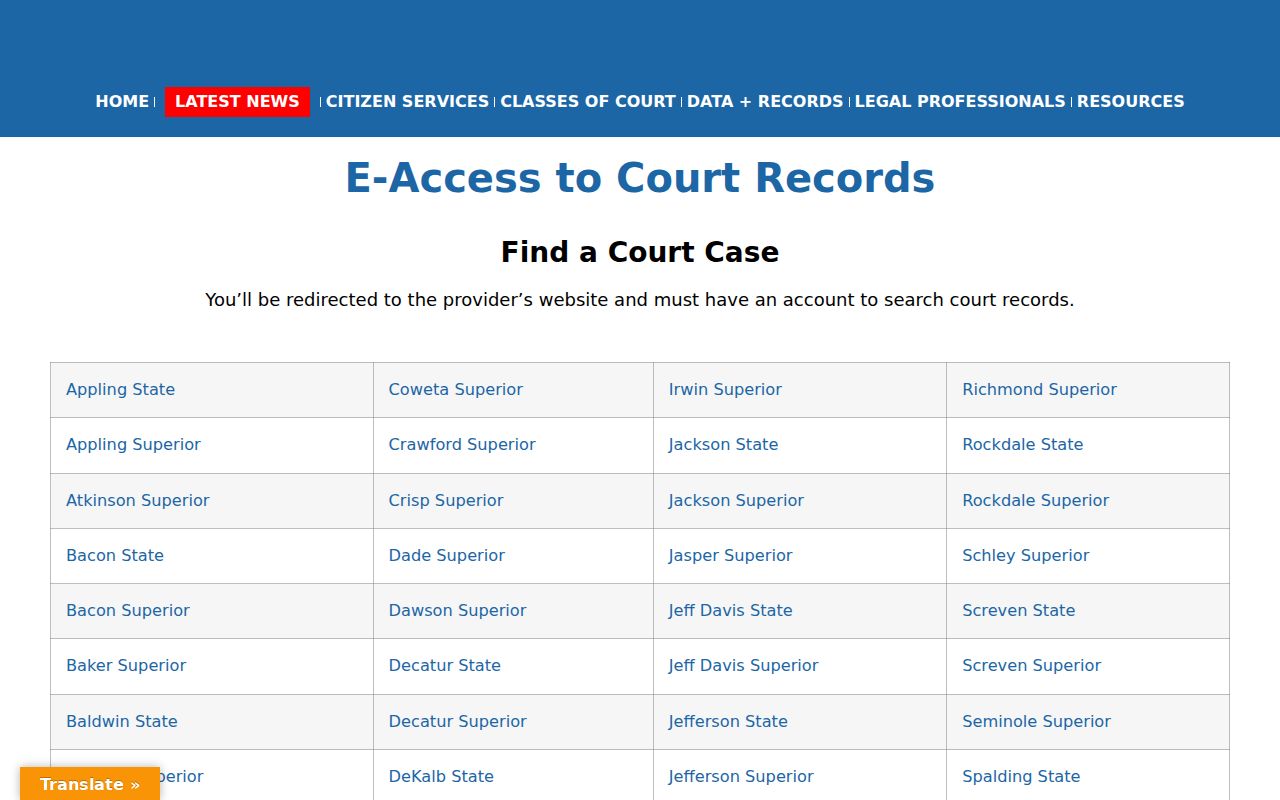
That directory page routes you to the right court; it is not a statewide case database of its own. Cases sitting in Magistrate, Probate, Juvenile, or Thomson Municipal Court belong with that court's own clerk. The McDuffie docket search page walks through name, number, and federal options in more detail.
- Identify the court and record type.
- Copy the full party name or case number.
- Use PeachCourt only for routed Superior access.
- Read dates, entries, and documents separately.
- Confirm important details with the clerk.
PeachCourt and the 2019 Shift
Every McDuffie Superior Court civil action must be filed electronically through PeachCourt. That rule has applied since January 1, 2019. The Clerk's Council brought in GreenCourt Legal Technologies to run the filing service. E-filing pushes pleadings into the court's case management system. Yet it does not make every document image free or public. Filing access, public docket display, and certified copies are three separate products.
Attorneys and non-attorneys alike pass through the free account gate. After signing in, choose Case Search, pick the county and court, and open the docket. For criminal dockets, the vendor's help material lists possible fields. These include co-defendants, prosecution and defense counsel, charges, disposition dates, calendar events, docket proceedings, and documents. The vendor also cautions that actual information varies.
Common mistake: an e-filed case is not necessarily an unrestricted file. A docket event can remain visible while its attached image is unavailable, redacted, sealed, or subject to a vendor charge.
Court Dockets: What They Show
A docket is the chronological record of a case. A calendar is different; it groups matters set for a particular date. The case file is different again, holding pleadings, orders, exhibits, and the rest. McDuffie's civil calendar offers a handy field model. It shows case number, caption, status, category, cause, filed date, service and answer dates, attorney role, phone fields, and markers like “Pro Se File” or “Diligent Search.”
Case numbers on the sample civil calendar combine a year, the letters CV, and a sequence. The caption names the parties. A filed date marks when the clerk accepted an item, and service means formal delivery. A motion asks the judge to act. An order is the judge's direction. A disposition records an outcome. When a hearing gets postponed, that is a continuance. The reset is the new setting.
| Docket | Chronological entries in one case |
|---|---|
| Calendar | Cases grouped for a setting date |
| Case file | Documents behind the entries |
| Certified copy | Clerk-authenticated record |
Room 1401 Is the Record Counter
For records in person, the route is 210 Railroad Street, Room 1401, Thomson, Georgia 30824. Gina Timmerman serves as Clerk of Superior Court, and the main line is 706-595-2134. Mail should go to P.O. Box 158, Thomson, GA 30824, and the published fax is 706-595-9150. Official material puts the Superior, Juvenile, Magistrate, and Probate functions inside the Railroad Street administrative complex. Each custodian stays distinct. The clerk's official page describes court case management as the unit that receives, files, stores, and retrieves Superior civil and criminal records. It also supports trial calendars, subpoenas, notices, and registry work.
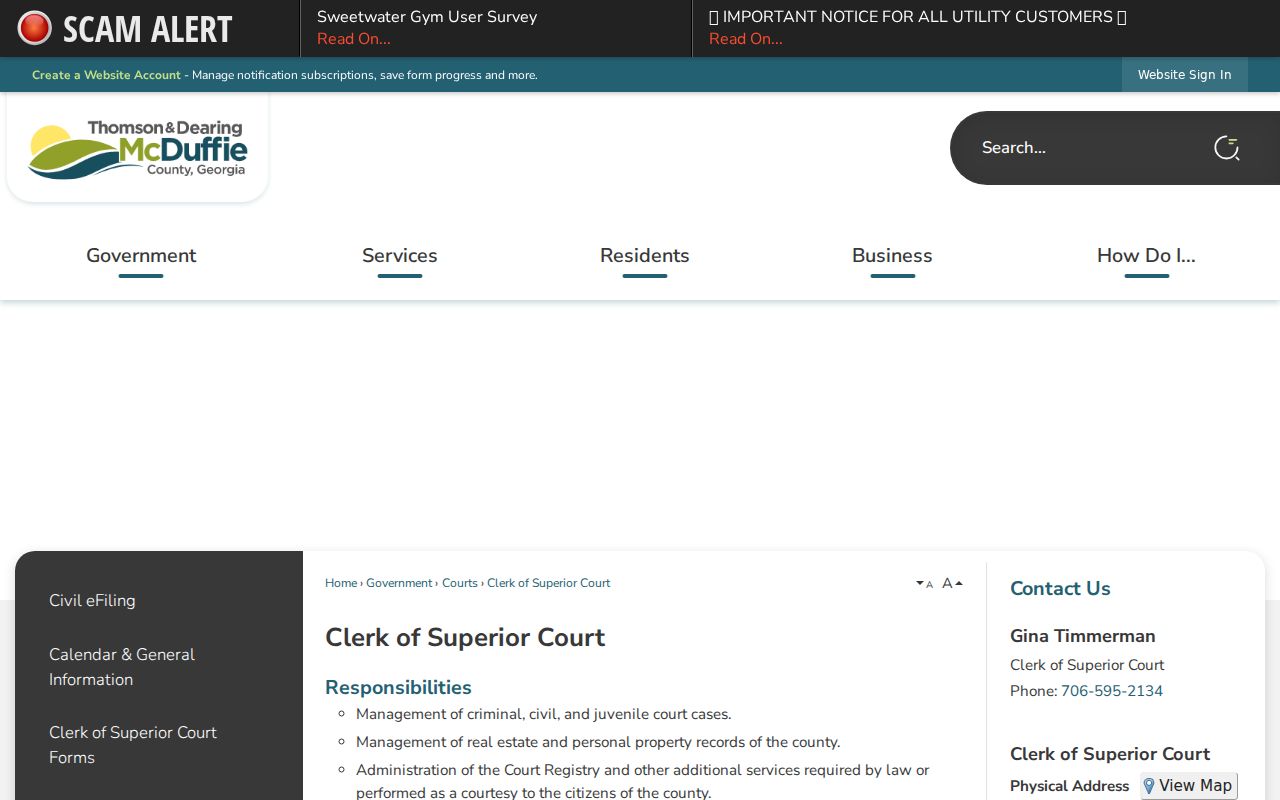
That clerk operation is the fallback, in person or by phone, whenever PeachCourt leaves a record question open. The directory also lists civil, criminal, juvenile, and real-estate deputies. Call ahead for an older file, a certified copy, or a date confirmation, since no terminal schedule, copy cutoff, or general turnaround is published.
McDuffie County Courts and Their Dockets
The official courts landing page maps the local court offices rather than offering one combined search.
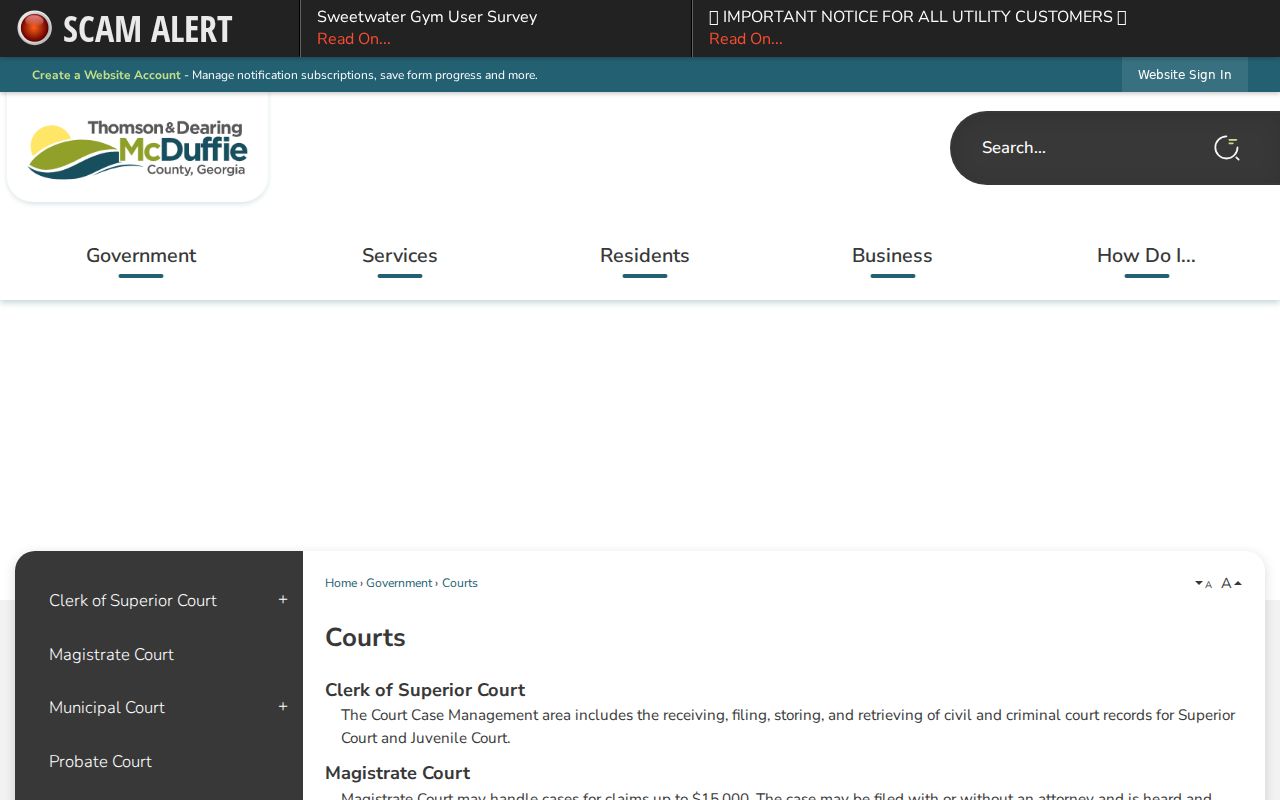
The directory shows why the right custodian matters. Superior Court hears felonies plus general-jurisdiction civil cases. Magistrate Court covers civil claims up to $15,000, garnishments, dispossessories, warrants, and first appearances. Juvenile Court handles youth matters under restrictive access rules. Probate Court, in turn, keeps wills, estates, guardianships, and its other assigned proceedings. Thomson Municipal Court runs its own traffic and ordinance docket.
| Court | Typical record | First channel |
|---|---|---|
| Superior | Felony and broad civil | PeachCourt or Superior Clerk |
| Magistrate | Small claims, dispossessory, warrants | Magistrate clerk |
| Probate | Estate and guardianship | Probate office |
| Thomson Municipal | City traffic and ordinances | Municipal clerk |
No McDuffie State Court appears in the current official directory or the Georgia E-Access listing. So do not chase that route when planning a search.
Four Courts Need Four Channels
The court pages separate county functions visually. The Superior Court page names the general-jurisdiction court and the Toombs Judicial Circuit.
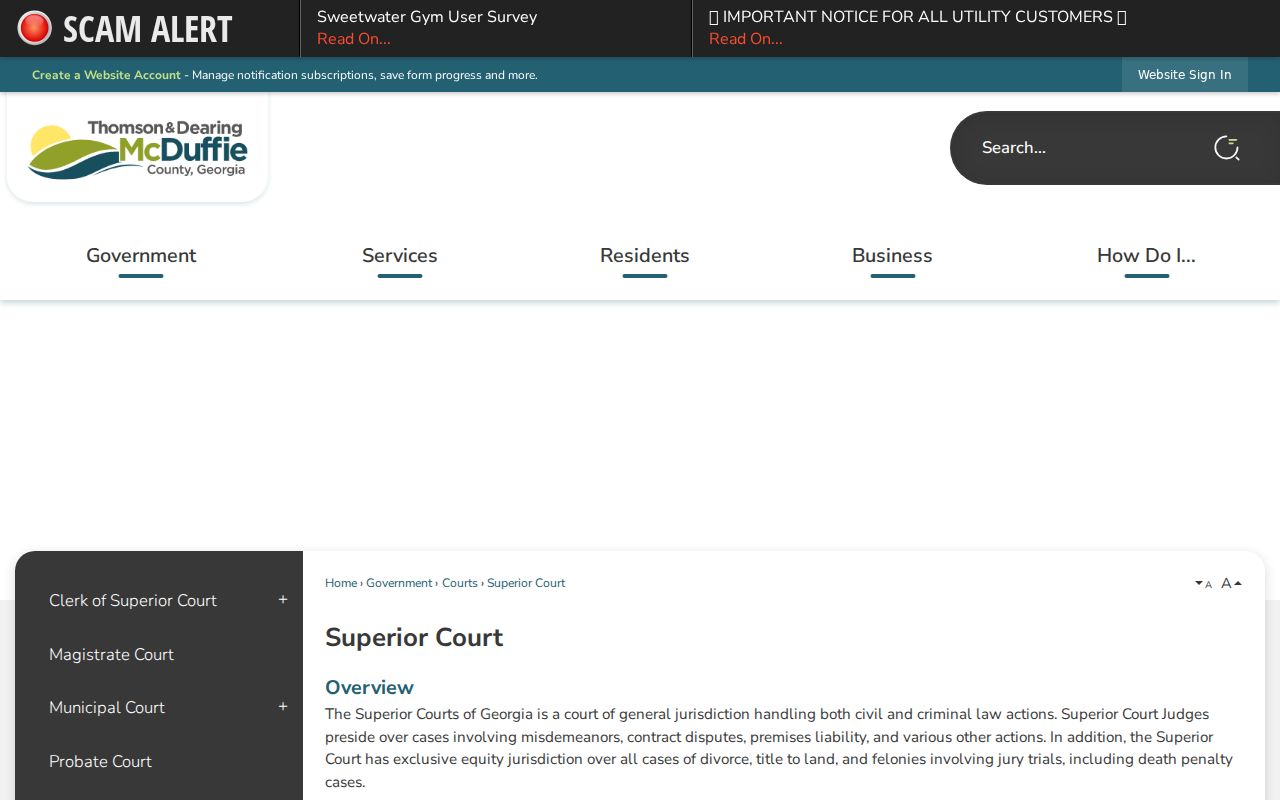
That Superior source belongs with PeachCourt and the Superior clerk, not a municipal ticket processor. The Magistrate Court source documents a different court and filing channel.
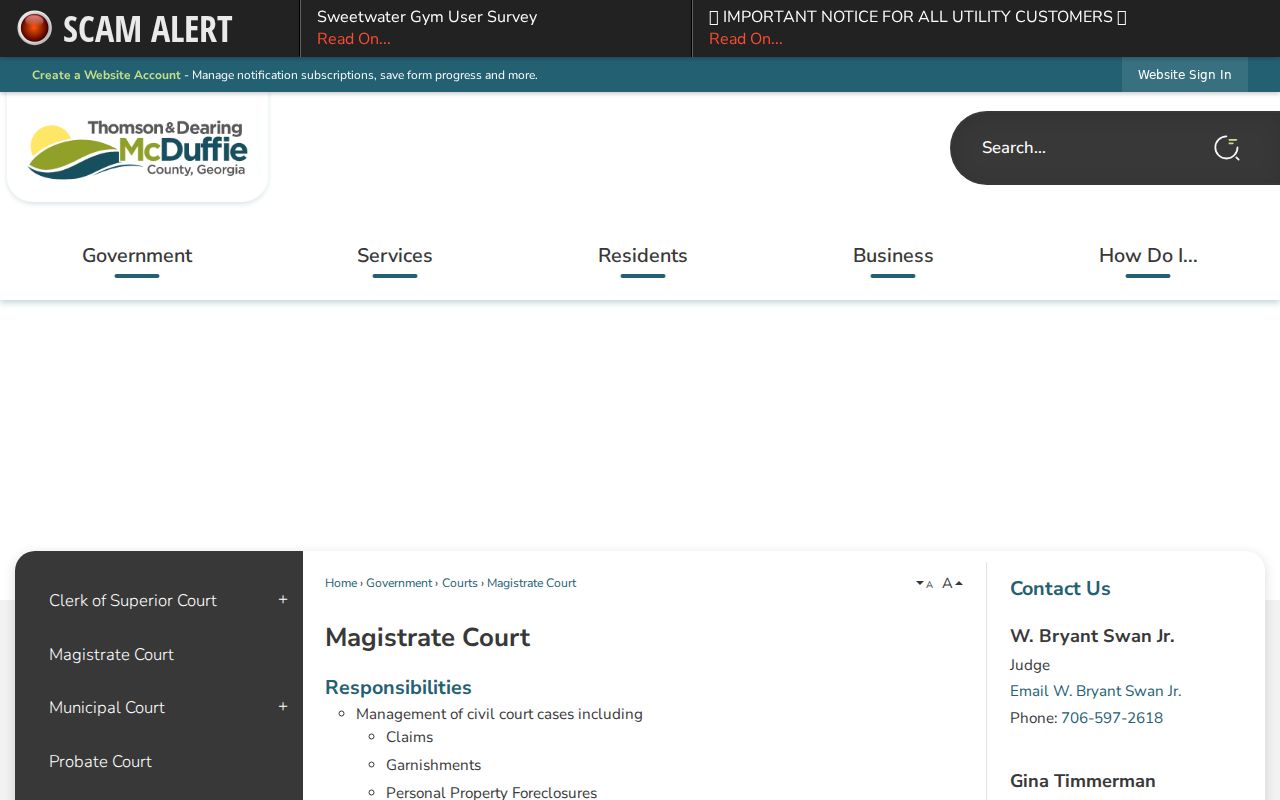
Magistrate claims can be started online through nCourt, but the county page publishes no general public Magistrate docket search. Filing a claim is one thing; searching all court records is another. On the Probate side, Valerie Burley's office stays separate from Gina Timmerman's clerk operation.
Court Dates and Settings in McDuffie County
Where does a McDuffie County court date actually surface? Look at the docket, a PDF calendar, the citation itself, a mailed notice, or a later order. Pull the case first. Then weigh the newest event against whatever calendar material the court has posted. The sample October 5, 2026 Superior civil non-jury calendar shows what a setting publishes: case number, caption, status code, category, cause, filing date, service, answer, and counsel. Remember it is one snapshot, not the whole file.
Codes like CL, OP, and JR appear with no public legend. Copy the code down and ask the clerk. Guessing is a bad idea. A "Pro Se File" marker flags a party representing themselves, and "Diligent Search" is another local marker whose exact effect only the file or the clerk can explain. Also confirm what kind of setting you are looking at, since a calendar call, a hearing, and a trial are different things.
Closures and resets change everything. A January 2026 emergency order from the Toombs Judicial Circuit closed McDuffie offices and tolled deadlines for the stated period. An older calendar may have been superseded for that very reason. The McDuffie court schedule page explains how to verify a date and what to do about a missed setting.
A Calendar Row Is Not the File
A calendar row tells you when and where a matter is set. It rarely tells you what each party filed. Nor does it show whether an image is public, or whether a later order changed the result. PeachCourt's docket view can add events and proceedings. But the clerk's file holds the authoritative documents. When you need an official copy, ask for the specific judgment, order, pleading, or docket sheet by name. A request for "the calendar" alone will not get you there.
What to do if dates conflict: note both sources and their update dates. Call the clerk with the case number. Ask which setting controls and whether a written order changed it. A request for continuance is not approval.
Thomson Municipal Court usually convenes on the second Tuesday at 1:00 p.m. at 210 Railroad Street. Confirm every city citation anyway. The municipal clerk sits at 309 Main Street and can walk you through procedure, though not legal advice. Dearing publishes no comparable municipal calendar.
Docket Access Under Georgia Law
Uniform Superior Court Rule 21 starts from open access to court records. Limits come from law and procedure. Any restriction order must name the protected material, its duration, and the reason. The stated harm must also outweigh public access. Rule 21.6 covers redaction of protected identifiers. So juvenile, adoption, court-sealed, and certain personal information can be masked or absent. That does not signal a broken docket search.
The Georgia Open Records Act, O.C.G.A. §§ 50-18-70 through 50-18-79, governs covered agency records. Under Georgia Attorney General guidance, Superior, Probate, and Magistrate court files are not treated like executive-agency records under the Act. Send a court-file request straight to that court's clerk. The McDuffie county form fits administrative records held by McDuffie County, Thomson, or Dearing. It does not fit a judicial custodian's files.
An absent row is not proof that no case exists. It can reflect a misspelled name, different court, processing delay, old paper file, juvenile restriction, sealing order, or redacted public view.
Certified PDFs and Public Screens
Certified copies of McDuffie County Superior and Magistrate records come through the GSCCCA eCertification service. Start by picking McDuffie County, the court, and the document type. Fill in the case fields it asks for. The clerk then processes the request. Payment authorization follows. A secure email link delivers the certified PDF.
A certified copy is not the same as saving a public court docket page to your own device. Certification means the clerk has authenticated that the copy matches the official record on file. The local instructions post no universal turnaround time and no McDuffie-specific copy price. So confirm both before you count on a deadline. The Superior fee schedule lists filing costs. It shows no clear line for docket copies.
For everyday inspection of a Superior court docket, try PeachCourt first when the case appears there. When it does not, go to the Room 1401 counter. You can also reach the clerk by phone, mail, or fax. One warning deserves attention. The office says it never calls about a missed appearance and asks for payment over the phone. Check any payment demand against official numbers.
How the Clerk Keeps Docket Records
Gina Timmerman's office receives, files, stores, and retrieves Superior civil and criminal material. It also backs calendars, subpoenas, juror processes, notices, and the court registry. The official clerk directory lays out separate desk routing inside that operation, so a request lands with the right deputy.
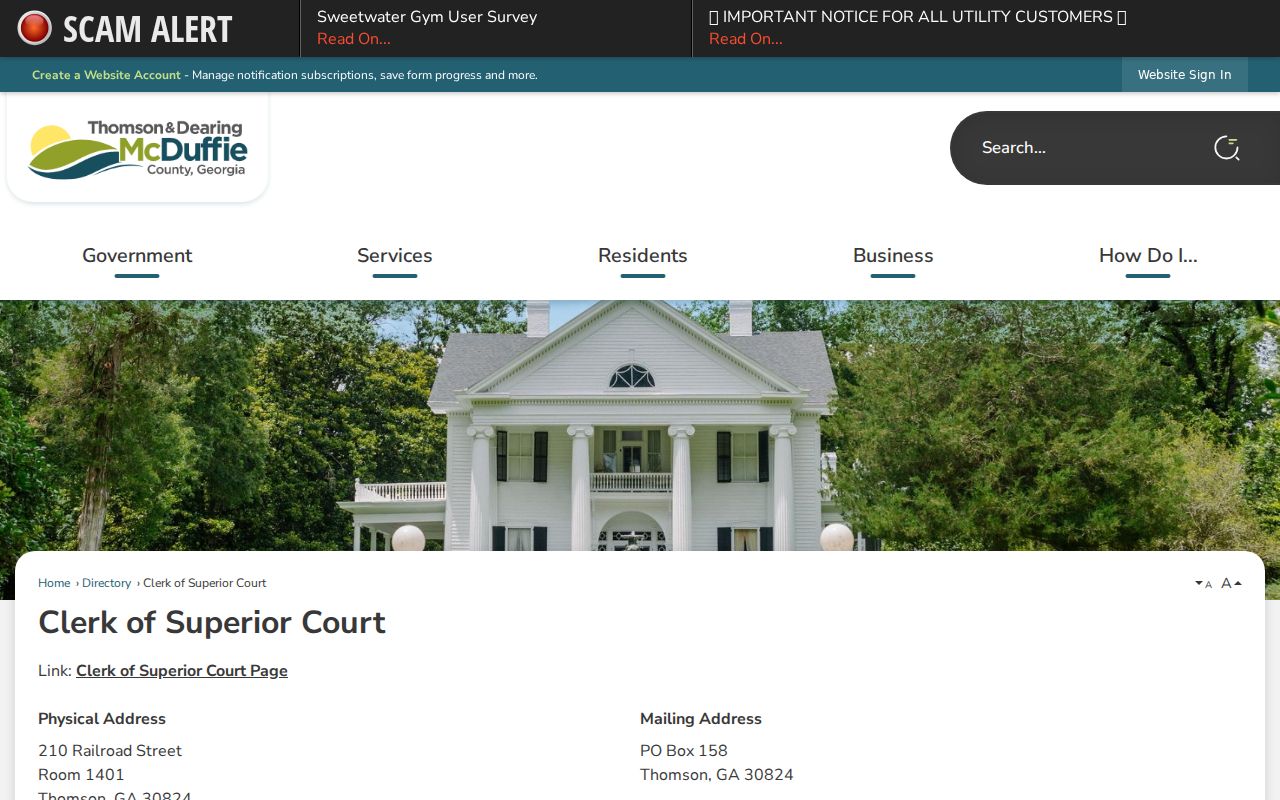
The directory routes a request to the relevant deputy rather than a generic county inbox. Call Civil Deputy Clerk at 706-595-2139, Chief Criminal Deputy at 706-595-2138, or Juvenile Deputy at 706-595-2137. The main desk is 706-595-2134. Probate Court runs separately. Its official source identifies the local Probate office.
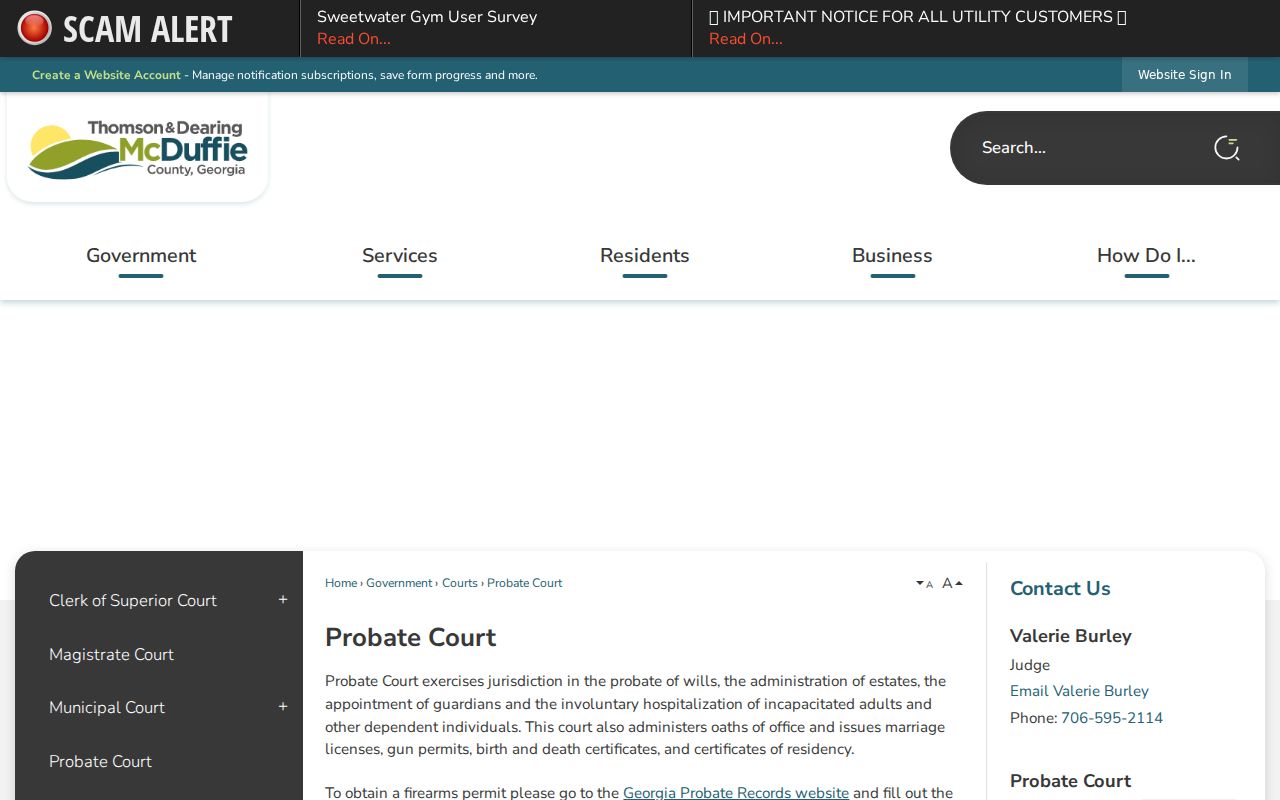
Probate sits apart from the Superior civil desk, even though both offices are at Railroad Street. Estate or guardianship records belong with Probate alone.
When Georgia Has No One Box
Georgia Courts says it plainly: no centralized traffic-citation database exists. ThomsonPay routes eligible Thomson Municipal citations through Government Window behind a CAPTCHA. Treat it as a payment channel, not the McDuffie County court docket. New citations can take seven to twenty-one business days to appear in a participating service. Thomson advises allowing at least ten days.
Read the issuing court and agency on the paper. A Thomson city violation likely belongs to Thomson Municipal Court. A county or other citation goes to the court named on it. Dearing's official town pages list no municipal court, calendar, or payment portal. So do not assume ThomsonPay covers it. When the court name is unclear, contact the issuing agency.
| Superior case | PeachCourt, then Superior Clerk |
|---|---|
| Thomson citation | Municipal clerk and ThomsonPay if eligible |
| Dearing citation | Court named by issuing agency |
| Federal case | PACER and Southern District clerk |
City-by-City Court Dockets in McDuffie County
McDuffie County contains two incorporated places. Thomson, with 6,814 residents in the 2020 Census, is the county seat and runs a named Municipal Court for city traffic, ordinances, and specified misdemeanors. Dearing counted 529 residents and keeps an administrative town web presence. It posts no official municipal court or docket interface.
Thomson Court Records
Use the Thomson Municipal clerk for city citations and settings. The clerk counter is at 309 Main Street, while regular sessions are held at 210 Railroad Street on the second Tuesday at 1:00 p.m. Superior, Magistrate, Probate, and Juvenile cases still use county courts.
Dearing Court Records
No Dearing municipal court is listed by official town sources. Read the issuing court on a citation, contact that clerk, and do not assume ThomsonPay. County court access is concentrated at 210 Railroad Street in Thomson.
The combined city-county home source supplies local civic context.
The local home image stands for a shared government web presence. It is not one shared docket database, since each McDuffie County court keeps its own records.
Federal McDuffie Cases Go to Augusta
Federal matters sit outside the McDuffie County clerk system. Federal law assigns the county to the Southern District of Georgia's Augusta Division. Those court records live in a separate world from the local docket. Use PACER or the Southern District's CM/ECF information route to search them. Need a human? The federal clerk answers at 706-849-4400. The courthouse sits at 600 James Brown Boulevard, Augusta, Georgia 30901. The official Augusta Division source identifies that federal courthouse.
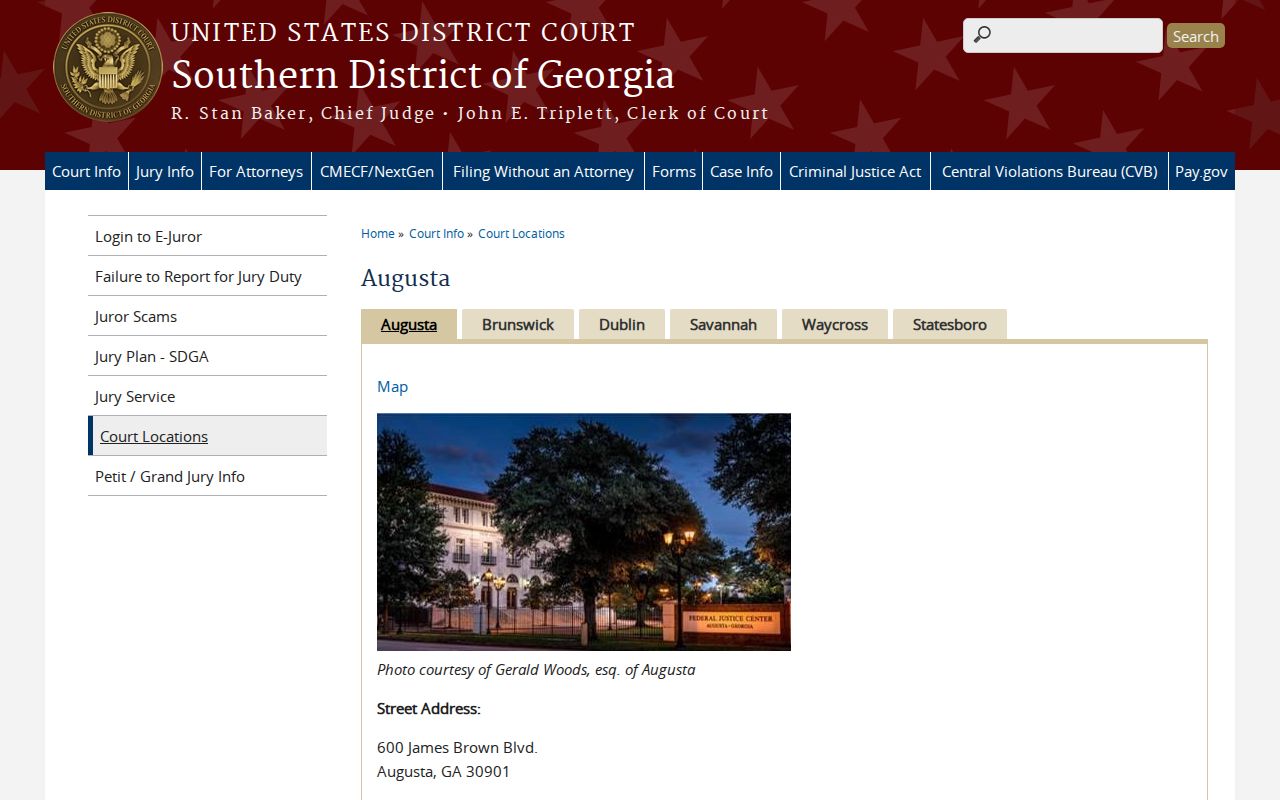
The federal image signals a different jurisdiction and a different search system. A federal case docket never shows up on PeachCourt. And a McDuffie Superior record never turns federal just because an event happened in the county. CourtListener offers a way to check public federal coverage. Still, PACER and the federal clerk remain the official channels.
Map and Directions to the McDuffie County Administrative Building
Superior, Juvenile, Magistrate, and Probate records are kept in Room 1401 of the county's Administrative Building at 210 Railroad Street in Thomson. This is the current records counter, not the historic McDuffie County Courthouse at 337 Main Street, which is civic and historic context rather than an active docket office. Thomson Municipal Court also holds its monthly sessions here, though its clerk counter is separately located at 309 Main Street.
McDuffie Clerk of Superior Court
210 Railroad Street, Room 1401
Thomson, GA 30824
Mail: PO Box 158, Thomson, GA 30824
706-595-2134
Monday through Friday, 8:00 a.m. to 5:00 p.m.
No public-terminal, parking, security-screening, or ADA/interpreter policy for the building was published, so call the clerk before an older-file, certified-copy, or court-date visit. Probate, Magistrate, and Juvenile share the same Room 1401 routing but keep separate custodians, so name the court when calling.